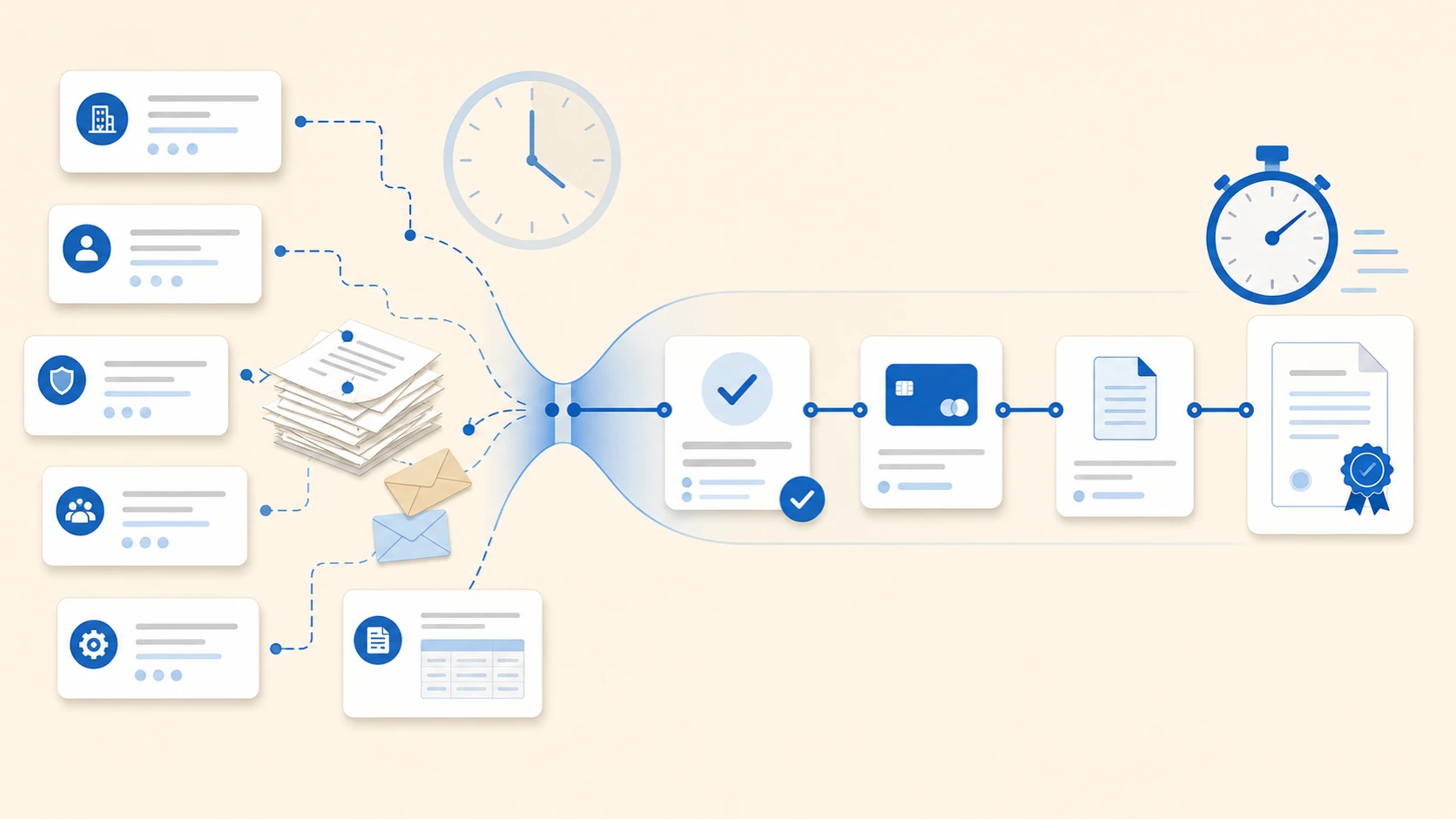
When two to three weeks pass between “underwriting approved this” and “the policy is issued,” the delay is almost never underwriting; it’s the handoffs after it: payment collection running through a separate invoicing loop, document assembly queued for a back office, data re-keyed between the underwriting file and the policy system, and compliance checks done manually at the end instead of enforced in the flow. Insurers that have eliminated this gap did it the same way: they made issuance an automatic consequence of approval, on a platform where binding, payment, documents, and filings are one flow rather than four departments. On modern systems, Viola by RegenAI InsurTech among them, the target for the approved-to-issued gap is minutes, not weeks (a benchmark we build toward, grounded in real workflow gains).
Anatomy of the 2–3 week gap
Map the interval at a typical carrier or MGA and you find the same five stations:
- The approval → billing handoff. Underwriting approves; someone raises an invoice; the applicant pays days later (or is chased); payment posts to a different system; someone reconciles it back to the file.
- Data re-entry. The underwriting workbench and the policy admin system are different systems, so the approved risk is re-keyed, with a review step to catch the re-keying errors, adding days to fix errors the process itself created.
- Document assembly. Dec pages, ID cards, and state-required forms produced by a back-office queue with its own SLA.
- Compliance checks at the end. Licensing and filing requirements verified manually as a final gate: occasionally bouncing the file back to the start.
- The e-signature loop. Signature packets sent late in the sequence, adding another round-trip.
Each station is individually defensible. Together they turn a decision that took a day into an issuance that takes three weeks, and every day of that gap is a window for the customer to bind elsewhere or for the risk to change.
How modern insurers close it
The fix is architectural, not managerial. You can’t SLA your way out of handoffs; you remove them.
Make binding one flow. On a modern PAS, approval doesn’t hand off to billing: payment is collected inside the bind flow, by card or ACH, with the charge amount derived server-side from the rated premium. On Viola, the sequence, quote created, premium rated against the active rate version, payment captured, policy bound, documents issued, is a single live flow, streaming in real time.
Never re-key an approved risk. The quote that was approved is the record that binds. One data core means the underwriting decision, the rating worksheet, the payment, and the policy are the same object at different stages: nothing to transcribe, nothing to reconcile.
Generate documents at bind, not after it. Declarations page, ID cards, welcome letter, and the e-signature packet are produced automatically the moment the policy binds: a by-product of issuance rather than a queue behind it.
Enforce compliance in the flow, not at the end. State licensing gates block issuance in unlicensed states before anything is bound; state-specific forms and filings (including SR-22 where required) resolve from effective-dated rules. The compliance check that used to bounce files back at day 15 happens computationally at minute one.
Keep human review for judgment, not logistics. Underwriter attention should be spent on risk decisions. When the questionnaire, rating, and compliance checks run in the flow, clean risks issue straight through, and human approval gates are reserved for the decisions that genuinely need them.
What this looks like in numbers
Viola’s headline outcome target is exactly this interval: from first quote to bound, paid, documented policy in minutes, not days, alongside 40%+ team productivity gains from end-to-end automation. Every number here is a benchmark we build toward, grounded in real workflow gains. The measurable claim any insurer should test in a demo: time the gap between “approve” and “customer holds documents” on your candidate platform, with payment included.
A note on partial fixes
Two common half-measures underdeliver:
- Adding an e-signature or payment tool to a legacy flow speeds one station while the queue simply reforms at the next. The bottleneck moves; the weeks remain.
- RPA (screen-scraping bots) bridging systems automates the re-keying instead of eliminating it: brittle, and the reconciliation burden stays.
The durable fix is a single core where issuance is the automatic consequence of approval. That’s an argument for evaluating platform generation, not point tools.
Viola is the AI-native, real-time Policy Administration System from RegenAI InsurTech. See a quote become a bound, paid, documented policy in one flow: book a demo.